
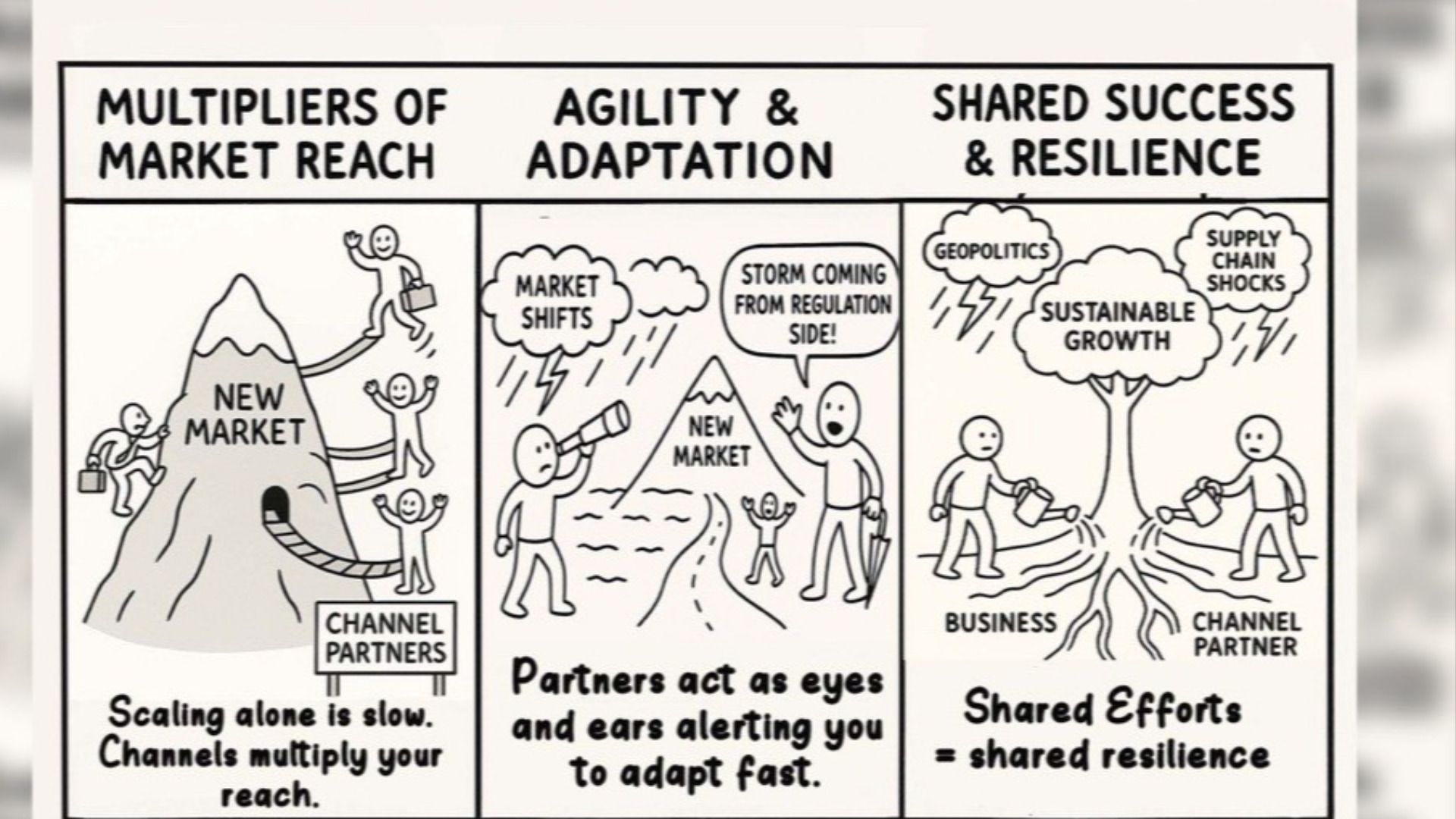
I discussed why channels are essential to B2B businesses, not merely as routes to market, but as true partners in extending brand and capability. Now, let’s move the conversation forward: how do channels become engines of sustainable growth, scalability, and resilience, especially in challenging or rapidly evolving markets?
After decades of working with channel partners at Hitachi Energy and grounding my approach in frameworks shared by industry thought leaders, I’ve seen that the right channel strategy doesn’t just complement growth. It multiplies it.
1. Channels as Multipliers of Market Reach
Business scaling extends beyond increasing headcount or establishing new offices. It requires efficient access to diverse and fragmented markets. Channels enable organizations to enter new regions, industries, or customer segments at a pace and cost advantage unattainable through direct expansion.
A few years ago, as we entered new global markets, it was channel partners who already understood local regulations, buyer expectations, and business culture. Their presence allowed Hitachi Energy to scale rapidly, going to market with speed and confidence while minimizing risk.
2. Catalysts for Agility and Adaptation
Sustainable businesses are characterized by both adaptability and scalability. Channels function as local intelligence sources, detecting shifts in demand, customer sentiment, and early warnings of regulatory or competitive changes. Acting on these signals by co-developing solutions or adapting offerings in real time maintains organizational relevance and competitiveness. As Ard-Pieter de Man stresses, alliances should be structured for shared intelligence and joint action. The most successful channel relationships are not static; they are built to flex as markets move, ensuring that both parties grow stronger together.
3. Shared Success, Shared Growth
For growth to be sustainable, the channel relationship must be a two-way street. Incentives, training, regular dialogue, and transparency are not ‘add-ons’; they are essential. When channel partners feel invested in and valued, they become willing co-creators of new business, not just resellers. At Hitachi Energy, investing in joint training and open communication with our partners led to the development of a new service offering that met an emerging customer need well ahead of the competition. This wasn’t just growth for us, it was new revenue and deeper customer engagement for our partners as well.
4. Building Resilience
Markets rise and fall. Disruptions, whether technological, geopolitical, or even natural, can and do happen. Channels give businesses built-in resilience. Local partners can maintain key customer relationships and continue service when direct teams face travel bans, supply chain disruptions, or regulatory hurdles. Steve Steinhilber’s alliance principles highlight this clearly: when you’ve cultivated trust and strategic alignment with your partners, you have a network that can help you weather any storm.
Summing Up: Growth That Lasts
The primary benefit of a robust channel strategy is not limited to short-term sales increases but includes steady, sustainable business growth. Channels drive scale, adaptability, and resilience, providing organizations with a multiplier effect that is difficult to achieve independently.
What’s your perspective? I’m keen to hear how others have seen channels spark growth or help their business become more resilient. How do you foster these win-win relationships in your organization?

I explored how B2B channel models have evolved from mere routes to market into strategic alliances: engines of growth, scale, and resilience. Today, as the business environment continues to shift, a pressing question emerges: How do we ensure our channel strategies remain relevant, agile, and future-ready?
Read More
Strategic Partners, not just routes to market Throughout my many years in energy sector marketing and sales, one truth has become increasingly clear: Channel distributors, resellers, and integrators are much more than just routes to market. They are strategic partners who amplify our reach, embody our brand locally, and enable us to grow sustainably in complex and evolving markets.
Read More
One of the books that will probably never age is Blue Ocean Strategy. The concept, the strategies, and the adaptability of these to any business under the sun remains relevant and will continue to do so. Taking for instance this last decade, we have seen new businesses emerge in categories we would not have predicted in the 90s especially the disruptors in many industry. We have also seen the existing, traditional,...
Read More
One of the many topics that I am passionate about is diversity. Maybe this is because of my own journey, having moved to Switzerland, from India and travelled in more than 40 countries in 4 continents under my belt. Assimilation, integration, and the feeling of belonging, in a new workplace or a new country is of paramount importance to succeed as an organization and as a society.
Read More
I recently came across a UN report on Sustainable Development Goal 7 (#SDG7), which is all about ensuring access to affordable, reliable, sustainable, and modern energy for everyone. In a world where we often hear troubling news, this report brought a ray of hope - it revealed that the number of people with access to electricity in 2018 had significantly increased since 2010.
Read More
Vistor Counter: 9120